
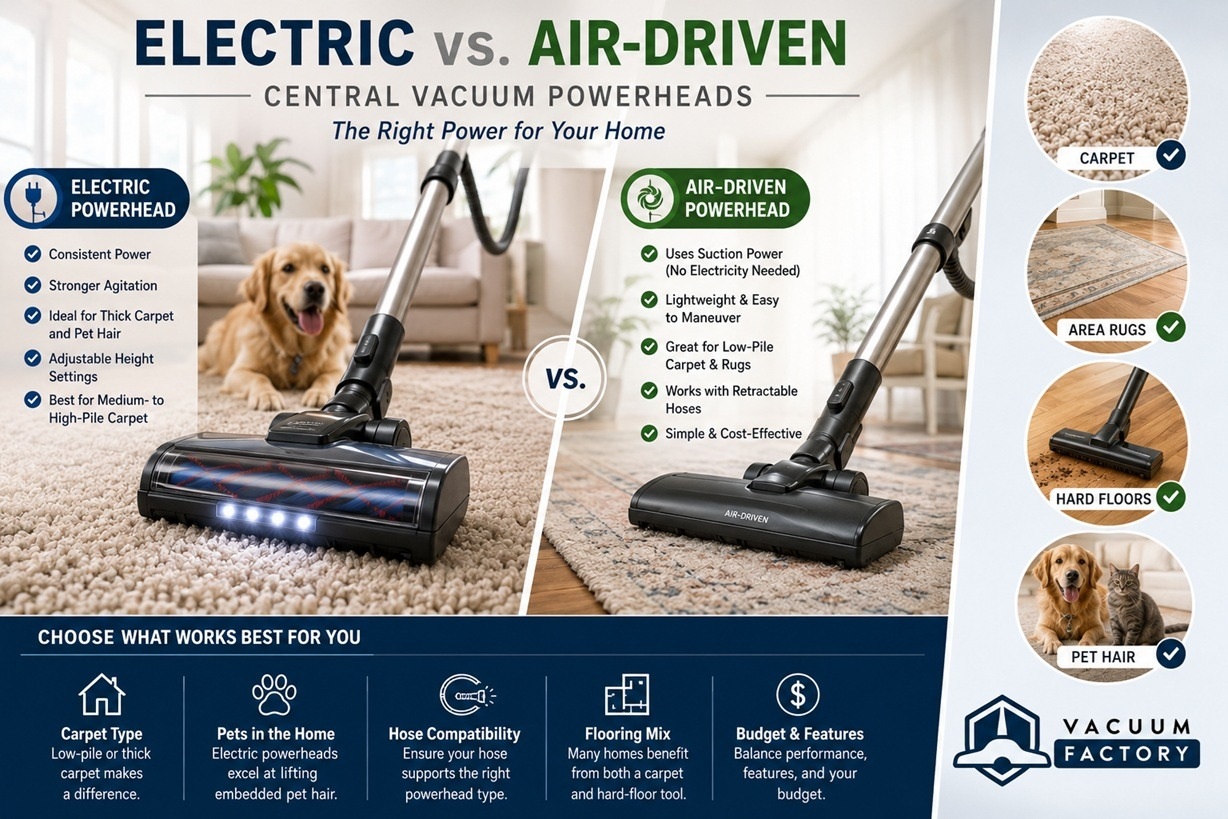
 Central Vacuum Powerheads: Electric vs. Air-Driven
Choosing the right central vacuum powerhead can make a noticeable difference in how well your central vacuum cleans carpet, rugs, pet hair, and everyday dirt. Although your central vacuum power unit creates the suction, the tool at the end of the hose determines how effectively that suction reaches dirt trapped inside your flooring.
Two of the most common choices are electric powerheads and air-driven, or turbine, powerheads. Both use a rotating brush roll to agitate carpet fibers, but they power that brush roll in very different ways.
Understanding those differences can help you choose the right powerhead for your flooring, hose type, cleaning needs, and budget.
Browse vacuum powerheads, nozzles, wands, and accessories at The Vacuum Factory to find replacement and upgrade options for many central vacuum systems.
What Is a Central Vacuum Powerhead?
A central vacuum powerhead is a floor nozzle with a rotating brush roll designed primarily for cleaning carpet. As the brush spins, it agitates carpet fibers and helps loosen embedded dirt, hair, lint, and debris so the central vacuum system can remove it.
Standard straight-suction floor tools rely only on airflow. By comparison, a powerhead adds mechanical agitation, which can significantly improve cleaning performance on carpet. These types of powerheads are designed for larger carpeted areas and are available in electric, battery-powered, and air-driven versions.
How Do Air-Driven Central Vacuum Powerheads Work?
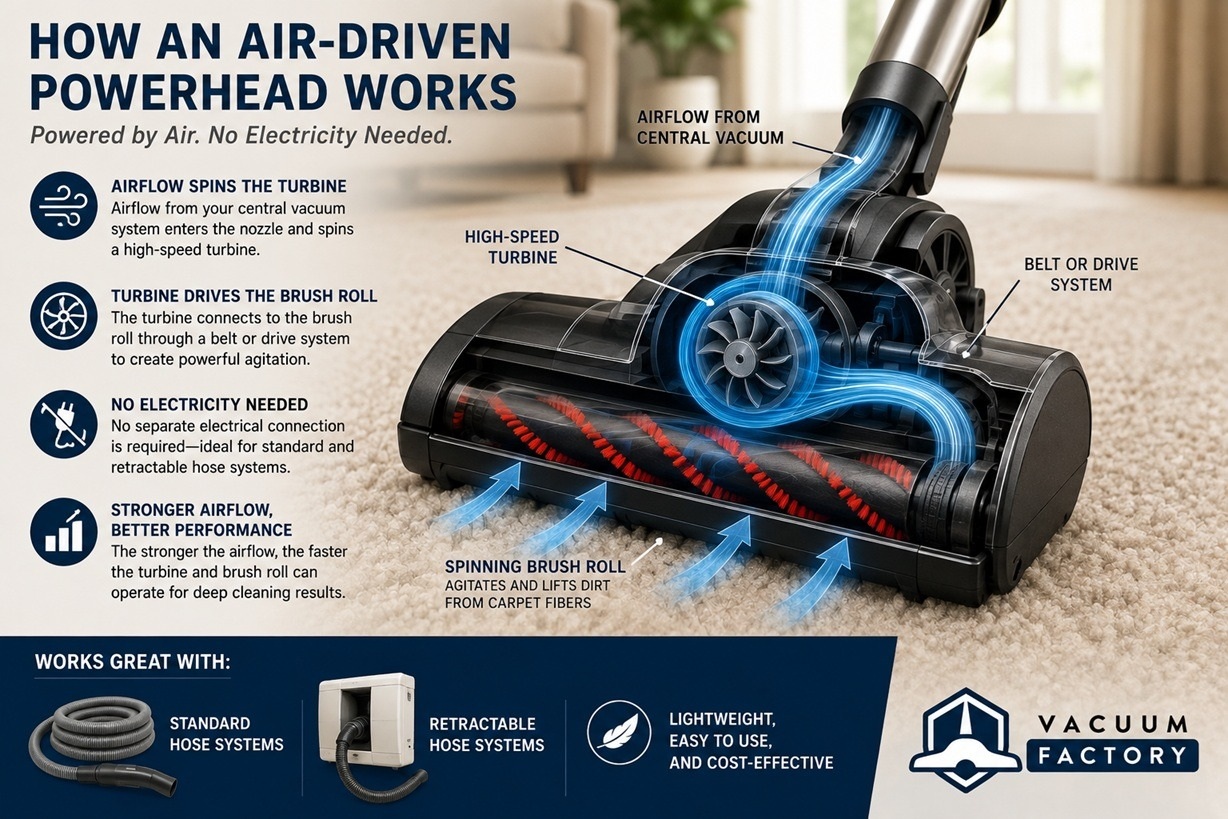 An air-driven central vacuum powerhead, sometimes called a turbine or turbo nozzle, uses the airflow from the central vacuum system to spin a small internal turbine.
That turbine connects to the brush roll through a belt or drive system. Therefore, no separate electrical connection is needed at the powerhead.
The stronger the airflow moving through the nozzle, the faster the turbine and brush roll can operate.
The Vacuum Factory explains that air-driven powerheads use a high-speed turbine powered entirely by the central vacuum’s airflow. Because they do not require additional electrical power, they can work well with many standard and retractable central vacuum hose systems.
- Advantages of Air-Driven Powerheads
- No electrical cord or power connection is required
- Generally lightweight and easy to maneuver
- Simple installation with many central vacuum hoses
- Usually less expensive than an electric powerhead system
- Useful for area rugs and low- to medium-pile carpet
- Good option for retractable hose systems
- Fewer electrical components to maintain
Air-driven nozzles can be especially attractive in homes that have mostly hard flooring with only a few carpeted rooms or area rugs.
Where Air-Driven Central Vacuum Powerheads Have Limitations
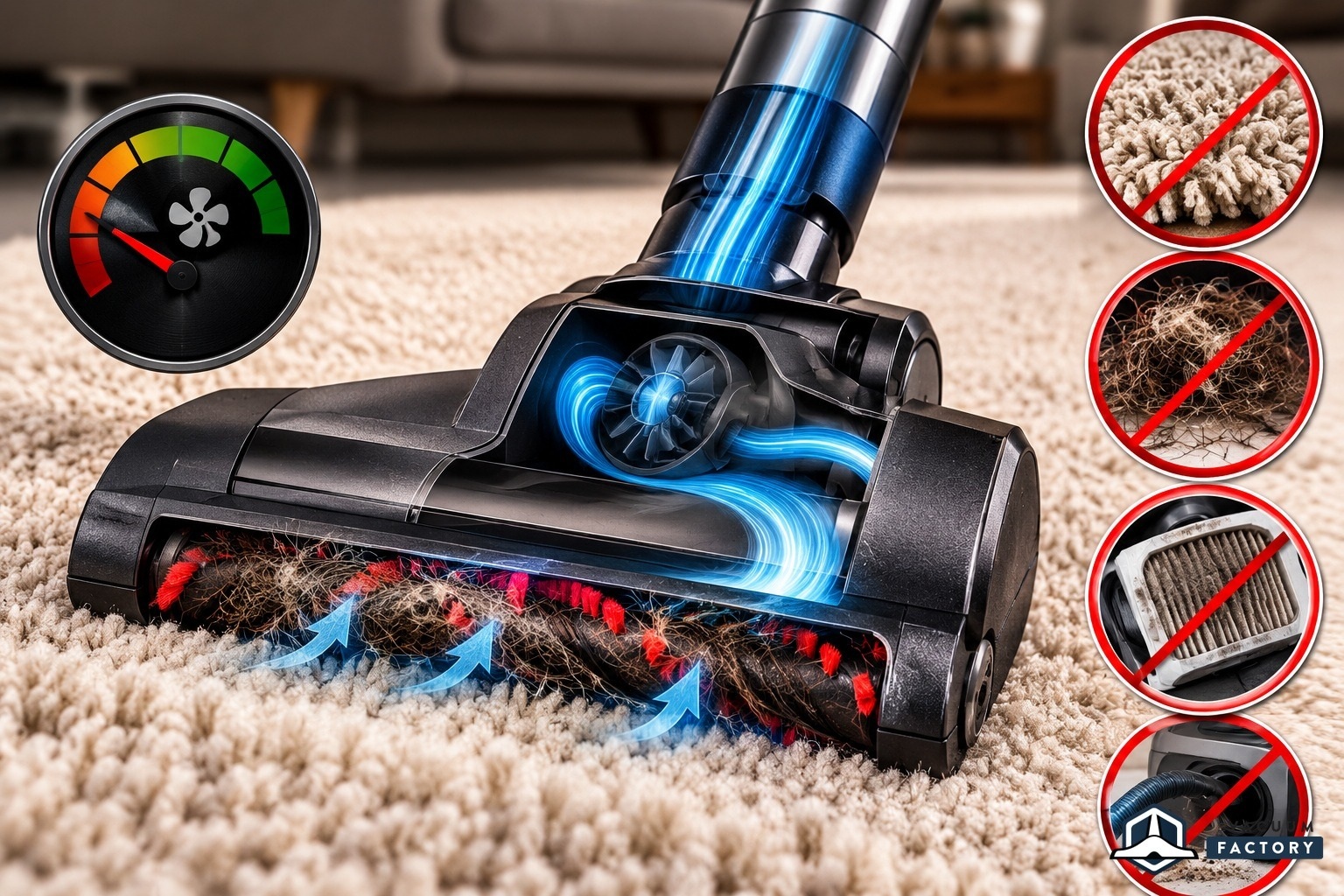 The biggest limitation is that the brush roll depends on airflow. When resistance increases, brush speed can decrease.
For example, thicker carpeting can restrict airflow through the nozzle. Hair wrapped around the brush roll, a clogged turbine, dirty filters, or reduced central vacuum suction can also affect performance.
Therefore, an air-driven nozzle may not provide the same consistent agitation as an electric powerhead when cleaning thick carpet or heavily embedded pet hair.
That does not mean turbine powerheads clean poorly. In the right home, they can provide an excellent balance of simplicity, weight, cost, and cleaning performance.
How Do Electric Central Vacuum Powerheads Work?
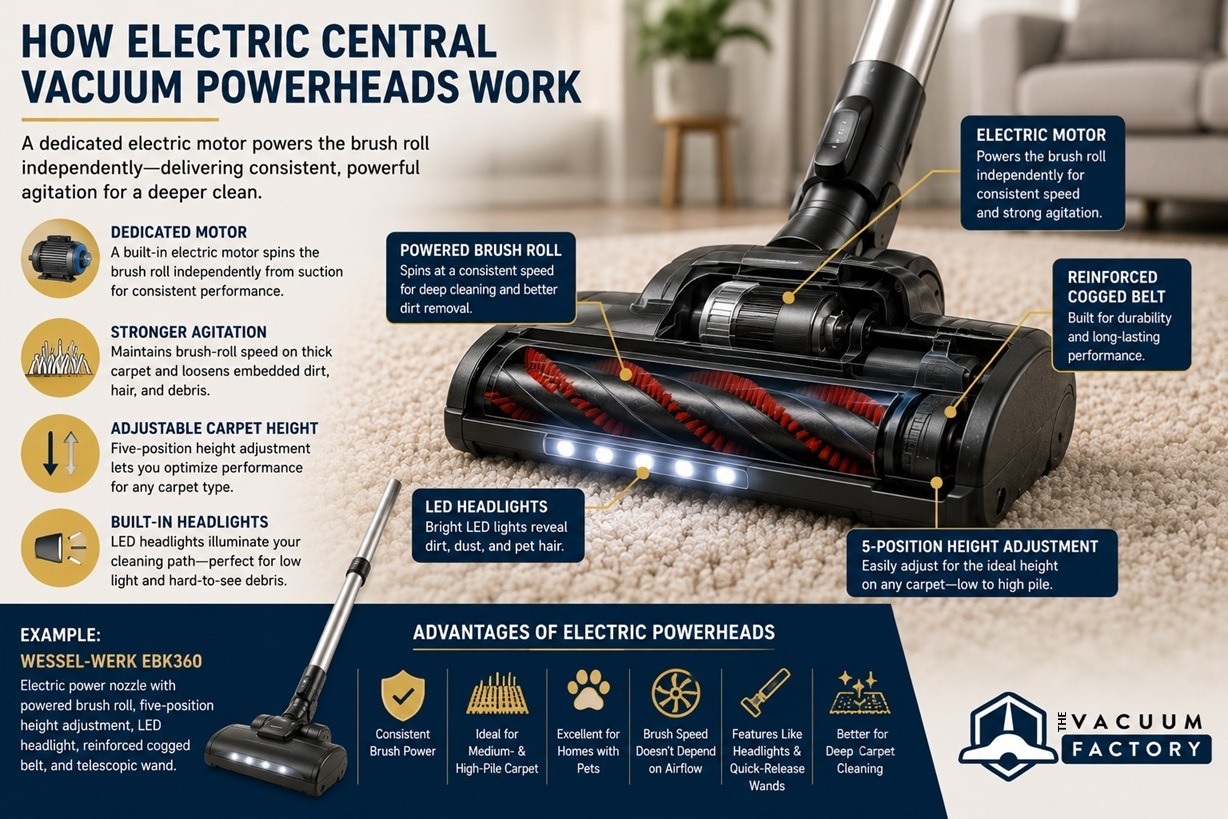 An electric central vacuum powerhead contains a dedicated electric motor that spins the brush roll independently from the vacuum’s suction.
Because the brush motor has its own power source, brush-roll speed remains more consistent even when the nozzle encounters thicker carpet or heavier debris.
This generally provides stronger carpet agitation and makes electric powerheads especially useful for homes with substantial wall-to-wall carpeting.
For example, the Wessel-Werk EBK360 electric power nozzle available from The Vacuum Factory includes a powered brush roll, five-position carpet height adjustment, an LED headlight, a reinforced cogged belt, and a telescopic wand.
Advantages of Electric Central Vacuum Powerheads
- Dedicated motor provides consistent brush-roll power
- Excellent for medium- and high-pile carpeting
- Strong agitation for embedded dirt and pet hair
- Many models include adjustable carpet height settings
- Brush speed does not depend entirely on vacuum airflow
- Often includes features such as headlights and quick-release wands
- Better suited for deep carpet cleaning
What Are the Drawbacks of Electric Powerheads?
The main consideration is that an electric powerhead needs electricity in addition to the airflow supplied by the central vacuum.
That means the hose and wand must be designed to deliver power to the nozzle.
Electric systems may use either:
- Pigtail electric hoses that plug into a nearby electrical outlet
- Direct-connect electric hoses that receive vacuum suction and electrical power at the wall inlet
If your existing central vacuum system has only a basic low-voltage hose, switching to an electric powerhead may require a new electric hose, compatible wand, and powerhead.
The Vacuum Factory notes that users converting from an air-driven powerhead to an electric model generally need both an electric powerhead and a compatible electric hose.
Electric vs. Air-Driven Powerheads for Carpet
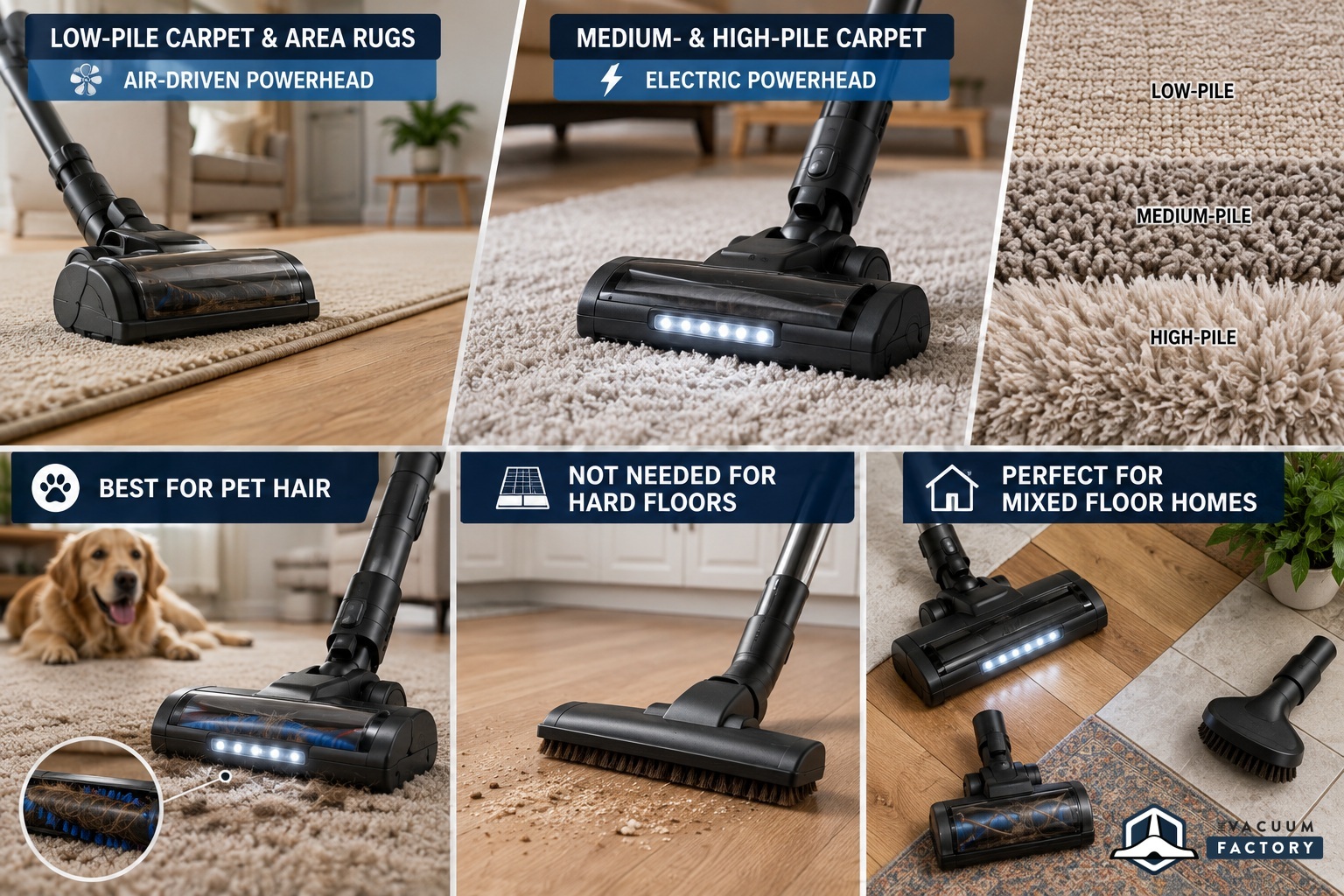 Your carpet type is one of the most important factors when deciding between these two designs.
Low-Pile Carpet and Area Rugs
Air-driven central vacuum powerheads can perform very well on low-pile carpet and many area rugs. Their lighter weight also makes them convenient when moving between hard floors and carpeted areas.
Medium- and High-Pile Carpet
Electric powerheads are generally the stronger choice when a home contains substantial medium- or high-pile carpet.
Because an electric motor spins the brush roll independently, the nozzle can maintain stronger agitation when carpet fibers create more resistance.
The Vacuum Factory’s own central vacuum power-nozzle guide recommends electric powerheads for medium- to high-pile carpeting, homes with pets, and users who want maximum carpet-cleaning performance.
Which Central Vacuum Powerhead Is Better for Pet Hair?
For homes with dogs or cats, an electric powerhead will usually provide the stronger carpet-cleaning option.
Pet hair often becomes wrapped around carpet fibers rather than simply resting on top. Therefore, strong brush-roll agitation helps loosen the hair before suction carries it away.
However, pet owners with mostly hardwood, tile, or laminate flooring may not need an electric powerhead throughout the entire home. An air-driven nozzle for rugs combined with a quality hard-floor brush may provide everything they need.
Do You Need a Powerhead for Hardwood Floors?
Usually, no.
Central vacuum powerheads are primarily designed for carpet. On hardwood, tile, vinyl, laminate, and other hard surfaces, a dedicated floor brush is often lighter, quieter, and more effective.
Hard-floor brushes use suction and soft bristles to collect dirt without the aggressive agitation required for carpet.
Titan Vacuums recommends bare-floor brushes for hard surfaces such as wood, tile, vinyl, and slate.
If your home has mixed flooring, many homeowners keep both a carpet powerhead and a dedicated hard-floor tool available.
Your Central Vacuum Hose Determines Compatibility
Before ordering a replacement powerhead, identify your hose type. This is one of the most important steps when upgrading a central vacuum system.
Common hose configurations include:
- Basic or low-voltage hose: Typically compatible with straight-suction and air-driven tools
- Pigtail electric hose: Uses a separate electrical cord that plugs into an outlet
- Direct-connect electric hose: Connects to an electrified central vacuum inlet
- Retractable hose: Often paired with straight-suction, air-driven, or battery-powered attachments depending on the system
Do not assume that every powerhead will attach to every hose. Connections, electrical fittings, wand styles, and hose handles can differ between manufacturers.
Electric or Air-Driven Central Vacuum Powerhead: Which Should You Choose?
An air-driven powerhead may be the better choice if:
- Your home contains mostly hard flooring
- You have low-pile carpet or area rugs
- You use a retractable or non-electric hose
- You prefer a lightweight nozzle
- You want a simple system without additional electrical connections
- You want to keep replacement costs lower
An electric powerhead may be the better choice if:
- Your home has extensive wall-to-wall carpet
- You have medium- or high-pile carpeting
- You have pets that shed heavily
- You want stronger carpet agitation
- You want adjustable carpet-height settings
- Your existing hose already supports an electric nozzle
Central Vacuum Powerheads: The Bottom Line
There is no single powerhead that is best for every central vacuum system.
Air-driven powerheads offer simplicity, lightweight handling, and compatibility with many non-electric hoses. Meanwhile, electric central vacuum powerheads provide stronger and more consistent brush-roll agitation for carpet, pet hair, and deep cleaning.
Before ordering, consider your carpet type, amount of hard flooring, pets, hose configuration, and existing central vacuum connections.
Most importantly, verify compatibility before purchasing. A high-quality powerhead will only perform properly when it is matched with the correct hose, wand, electrical connection, and central vacuum system.
Shop vacuum powerheads and floor nozzles at The Vacuum Factory or browse our complete selection of vacuum hoses, attachment kits, wands, floor tools, belts, brush rolls, and replacement parts.
If you are unsure which central vacuum powerhead fits your current hose or system, contact The Vacuum Factory at 877-822-7868 for help identifying the correct setup.
“`